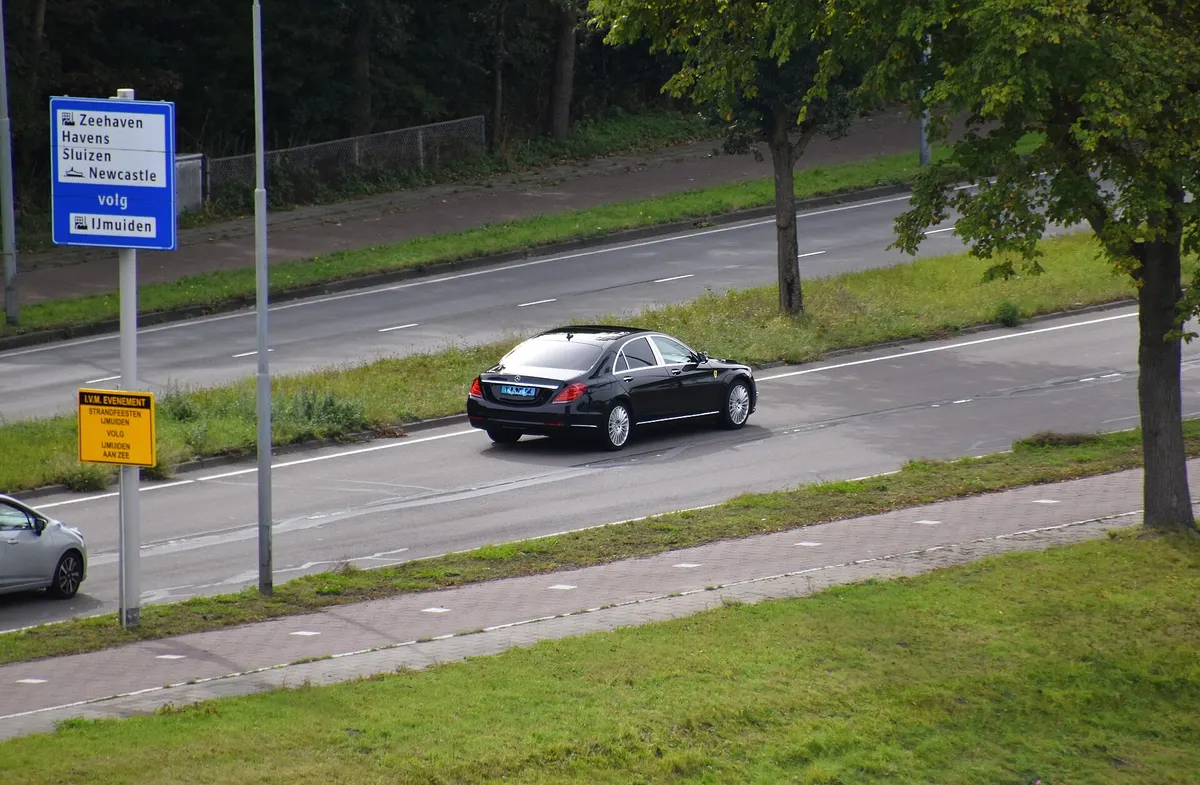
2013–2020. Saloon W222, long wheelbase V222, Maybach X222, Pullman VV222. Tell us the chassis number and what the car is doing, and we will come back with the part, the price and the lead time.
An S-Class W222. Shown to help you confirm the generation — trim, lights and bumpers vary within it.CC0 · Wikimedia Commons
Every part
Parts for the W222
All 415 parts across 16 systems, from brake discs to AIRMATIC struts. Search it, or open the system that matches what the car is doing — the symptom is written on every one.
415 parts across 16 systems
Brakes31 parts+
Everything that slows and stops the car.
You are here because: Squealing or grinding when braking, a soft or long pedal, a brake warning light, or pulling to one side under braking.
To quote this we need: Front or rear, and whether the car has the sports or AMG brake package — the disc diameter changes with it.
What holds the wheels to the car, absorbs the road, and points the car where you steer.
You are here because: Knocking over bumps, the car sitting low on one corner, wandering or heavy steering, uneven tyre wear, or an AIRMATIC warning.
To quote this we need: Whether the car is on steel springs or air suspension. On Mercedes this changes the part completely and it is the most common mis-order.
The sensors the car reads and the modules that decide what to do about them.
You are here because: A warning light with no obvious fault, a fault code from a scan, windows or locks that stop working, or intermittent electrics.
To quote this we need: The fault code if a garage has scanned it. Many modules must be coded to the car after fitting — that is a job as well as a part.
Seeing and being seen — and on a modern Mercedes, one of the most expensive things to replace.
You are here because: A cracked or fogged light, a bulb out, condensation inside the unit, or a lighting fault on the dash.
To quote this we need: Whether the car is halogen, xenon or LED, and pre- or post-facelift. Lights change inside a generation more than any other part.
Panels, glass and trim — what an accident, a car park or the sun damages.
You are here because: Accident damage, a dent or rust, a knocked-off mirror, peeling trim, or a cracked screen.
To quote this we need: A photograph, the chassis code and the paint code. Paint code is on the data sticker; panels are usually supplied primed, not painted.
Everything inside the cabin, including the parts the Gulf sun destroys first.
You are here because: A cracked or sticky dashboard, a sagging roof lining, a broken switch or handle, worn seat bolsters, or a rattle from the trim.
To quote this we need: Trim colour and code from the data sticker. The same part is made in several finishes and they are not interchangeable to look at.
Complete assemblies from stripped cars, where a new part is not proportionate to the job.
You are here because: An expensive assembly has failed on an older car, or an insurance repair has to be done at a price that makes sense.
To quote this we need: Chassis number and a photograph. We will say plainly whether a part is new or used — a used part sold as new is not a saving, it is a problem later.
These are the parts a Mercedes-Benz S-Class W222 (2013–2020) is built from, not a stock list. We source genuine, OEM and aftermarket and will price them side by side — send the chassis number and we will confirm the exact part before anything is ordered.
The detail on this car
Make sure this is your carchassis code, years and body variants
Make sure this is your car
The W222 was built 2013–2020. Two S-Class cars a year apart can be different generations and share almost no parts, so the chassis code — not the model name and not the year — is what decides fitment.
Worth knowing. AIRMATIC standard, with MAGIC BODY CONTROL on some cars — that reads the road ahead with a camera and is a different system again. The 2017 facelift brought the M256 straight-six and the nine-speed gearbox.
Not sure which one you have? Read the chassis number off your mulkiya, or from the base of the windscreen on the driver's side. Send us all seventeen characters and we will tell you the generation, the body and usually the engine. How to read it.
Which engine do you havebadge on the boot to engine code
Which engine do you have
Engines fitted to the W222
Find the badge on the boot of your car in the left column. The code beside it is what we order parts against — several groups below need it, and emissions parts need it most.
Badge on the car
Engine code
Engine
Fuel
S 320 / S 400 / S 500 e / S 560 e
M276
3.0 V6 biturbo
petrol
S 400h
M276
3.5 V6
petrol
S 500 / S 550
M278
4.7 V8 biturbo
petrol
S 450 / S 500 (2017 on)
M256
3.0 straight-six turbo mild hybrid
petrol
S 560 (2017 on)
M176
4.0 V8 biturbo
petrol
S 600
M277
6.0 V12 biturbo
petrol
S 63 AMG
M157
5.5 V8 biturbo
petrol
S 63 AMG 4MATIC+ (2017 on)
M177
4.0 V8 biturbo
petrol
S 65 AMG
M279
6.0 V12 biturbo
petrol
S 350 d / S 350 BlueTEC
OM642
3.0 V6 turbo
diesel
S 300h / S 300 BlueTEC HYBRID
OM651
2.1 turbo hybrid
diesel
S 350 d / S 400 d (2017 on)
OM656
2.9 straight-six turbo
diesel
Not every engine reached every market — the UAE range is predominantly petrol. If your badge is not listed, or the car has been re-badged, the engine code is stamped on the block and printed on the data card; send the chassis number and we will read it off that instead.
What goes wrong on this carresearched per engine, with sources
Known faults
What goes wrong on the W222
Researched per engine and per chassis, with the source shown against each one. If what your car is doing is on this list, you already know roughly what you are buying.
On the W222 itself
Faults that belong to the car rather than to whichever engine is in it.
If your car has AIRMATIC
Reported across every platform once past roughly 100,000–120,000 km
The car sitting low on one corner or at one end overnight, a compressor running and running, or an AIRMATIC warning on the dash.
Almost every AIRMATIC fault traces to one of four things: a leaking air strut, a worn-out compressor, a stuck relay, or a failing ride-height sensor. They are not interchangeable diagnoses and they are not the same money. A relay is the cheapest thing on that list and is worth eliminating first — on the W211 it is the 40 amp K67 AIRMATIC relay at position F74 under the bonnet. A compressor that has been working against a leaking bag for months usually needs replacing alongside the bag, so a car with one corner down is often a two-part job, not one.
These are known faults, not your car’s faults. Plenty of these cars never see any of them, and several of the faults above look identical from the driver’s seat while needing completely different parts. Have it scanned, send us the codes and the chassis number, and we will quote what it actually needs rather than what it might.
On the engines fitted to it
Check the engine code against the badge on your boot in the table above — a fault on one engine tells you nothing about the others.
Cold-start rattle from the secondary chain tensioners
M276
A rattle of a second or two on start-up, then silence.
Oil does not reach the secondary tensioners quickly enough at start-up. The proper fix is the revised tensioners together with check valves to hold oil in the circuit — fitting new tensioners alone often brings the noise straight back.
Check engine light, rough running, and a camshaft position code — usually on the intake side.
An internal pin inside the adjuster wears down and lets it skip. On most M276 engines it is the intake adjusters that go. Poor oil quality and long intervals bring it on sooner. The tone wheel on this engine can also rotate on the camshaft and throw the same sort of code with the chain intact.
Start-up rattle, or a camshaft timing code with the engine otherwise running normally.
The V8 shares the M276's adjuster and tensioner behaviour — worn adjuster pins, tensioners slow to fill on start-up, and stretched chains or damaged guide rails as the second-order damage. Diagnose which of the four it is before buying: they present identically from the driver's seat.
Carbon build-up, coolant pump and 48V system faults
M256
Rough cold running, a coolant loss, or an electrical fault tied to the starter-generator.
The known cluster on this engine is carbon on the intake valves, coolant pump failure, complexity around the 48-volt integrated starter-generator, and timing chain wear. The ISG is not a conventional starter motor and is not priced like one.
Oil leaks around the cam covers, the oil cooler or the sump, often with no single obvious source.
The widespread oil leaks on the 4.0 V8 are usually the PCV oil separators rather than the cylinder head. When a separator clogs, crankcase pressure rises and pushes oil past whichever gasket is weakest. Replacing gaskets without fixing the separator buys the same leak again.
Check engine light, and an oil pump code from a scan.
The usual failure is electrical rather than mechanical — a broken wire inside the oil pan, not a seized pump. That matters enormously to the price, so establish which it is before ordering a pump.
Oil leaks, a misfire under load, or rough cold running with poor economy.
Same PCV-driven oil leaks as the M176. On top of that, ignition coils fail with age, and because this is direct injection there is no fuel washing the intake valves — carbon builds on them and is cleaned mechanically rather than with an additive. Timing chain stretch is reported on higher-mileage engines.
Misfire codes, or oil seeping around the cam covers.
The later development of the M275 and it inherits the same ignition layout — coils supplied per bank rather than singly — and the same tendency for cam cover gaskets to weep oil onto them. Twelve cylinders means twelve of everything, which is the whole cost story on this engine.
Oil leaking from the back of the engine, often mistaken for a rear main seal, and oil dripping onto the gearbox.
The oil cooler sits in the V of the engine and its seals cook. Mercedes moved to Viton seals as the factory standard in 2010 for exactly this reason. The seals themselves are cheap; the published book time for the job is 12.3 hours, which is the entire story of this repair — quote the labour, not the O-ring.
Engine management light and the car refusing to rev past roughly 3,000 rpm.
The swirl flap motor sits below the turbo. Oil from a leaking turbo seal runs down into its electrics and kills it. Replacing the motor without finding where the oil came from buys the same fault again.
Turbo actuator failure and the turbo inlet pipe seal
OM642
Limp mode, no boost, or a boost-deviation code under load.
The actuator is one of the most common failures on this engine. The red turbo inlet pipe seal is the other — most of the time it has either been fitted wrongly or has swollen and never been changed, and it can take the inlet port shut-off motor with it.
OM651Reported from around 150,000–180,000 km on 220 CDI cars
Loss of power, limp mode, smoke, or a whistle that changes with load.
A known wear-out on the higher-mileage diesels rather than a design defect. Worth checking the oil feed and the intake side before fitting a turbo — a turbo that failed because of oil starvation will fail again.
Rough idle, hard starting, a diesel smell, or a rattle from the front of the engine.
The common diesel trio on this engine: injectors and their seals, chain and tensioner wear, and a fuel filter housing that leaks. Injectors are coded to the engine and usually to the cylinder, so the codes have to be written to the ECU after fitting — the part on its own does not finish the job.
These are known faults, not your car’s faults. Plenty of these cars never see any of them, and several of the faults above look identical from the driver’s seat while needing completely different parts. Have it scanned, send us the codes and the chassis number, and we will quote what it actually needs rather than what it might.
If it is the gearbox
Mercedes fitted the five-speed, seven-speed and nine-speed automatics across overlapping years, so we read the gearbox code off your data card rather than guessing it from the model year. If yours is a 722.9, this is the fault to know about.
722.9 conductor plate and valve body
Harsh or jerky changes, holding a gear too long then slamming into the next, or dropping into limp mode.
The conductor plate is the control module mounted on the valve body. When it breaks down internally it can no longer read input shaft speed properly, so it cannot judge torque converter slip and the lock-up goes wrong — which is what you feel. It usually starts intermittent and always becomes permanent. The other failure is mechanical wear in the valve body bores, and the two feel the same, so diagnose before buying: one is a module and the other is a valve body.
These are known faults, not your car’s faults. Plenty of these cars never see any of them, and several of the faults above look identical from the driver’s seat while needing completely different parts. Have it scanned, send us the codes and the chassis number, and we will quote what it actually needs rather than what it might.
Questions we get askedchassis number, genuine or aftermarket, lead times
Questions we get asked
Which years is the W222 S-Class?
2013–2020. Body variants: Saloon W222, long wheelbase V222, Maybach X222, Pullman VV222. Cars built in a changeover year can be either generation, so if yours sits on the boundary send the chassis number and we will confirm which one it is before anything is ordered.
How do I find my chassis number?
In the UAE the quickest place is your mulkiya — the vehicle registration card. On the car it is at the base of the windscreen on the driver's side, and on the sticker inside the driver's door jamb. It is seventeen characters and all of them matter.
Do you supply genuine, OEM or aftermarket parts?
All three, and which one makes sense depends on the part and the car. A wear item on a high-mileage car rarely justifies a genuine price; a sensor or a control module usually does. Tell us the part and the car and we will price the options side by side rather than choosing for you.
Can you supply used parts?
For body panels, lights, interior trim and some assemblies, yes. For wear items and safety parts we will normally recommend new. We will say which we are quoting — a used part sold as new is not a saving, it is a problem later.
How long does it take?
Parts held in the UAE are usually same or next day. Anything ordered in takes longer and we will tell you the lead time with the price, before you commit, rather than after.
Get in touch
Need a part for a W222?
Send the chassis number and a photograph of the part or the damage. We will come back with the options — genuine, OEM or aftermarket — with prices and lead times side by side.