
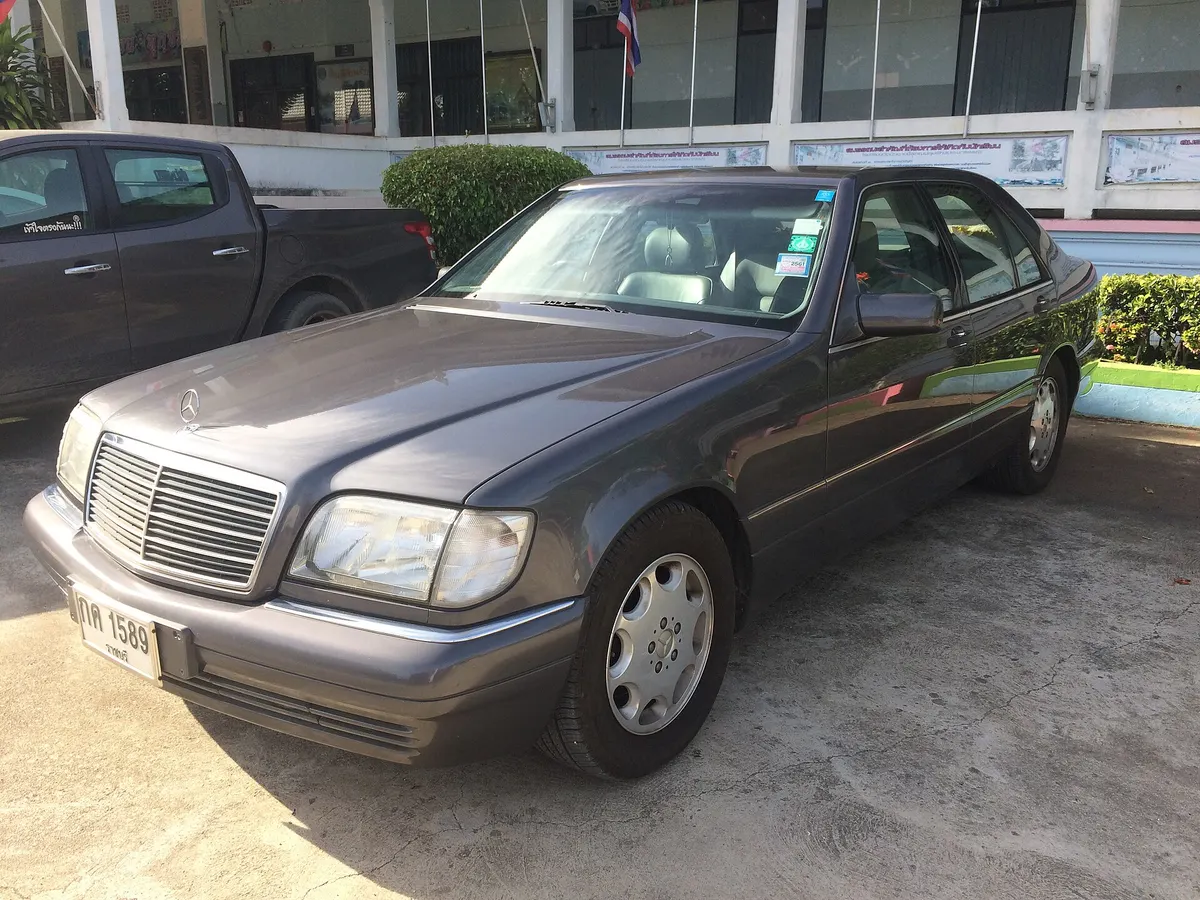
Mercedes-Benz parts

S-Class W140 / C140

1991–1998. Sold as the The C140 coupé became the CL-Class in 1996. Saloon W140, long wheelbase V140, coupé C140 (renamed CL-Class in 1996), Pullman. Tell us the chassis number and what the car is doing, and we will come back with the part, the price and the lead time.

Every part

Parts for the W140 / C140

All 415 parts across 16 systems, from brake discs to AIRMATIC struts. Search it, or open the system that matches what the car is doing — the symptom is written on every one.

415 parts across 16 systems

Brakes31 parts
Suspension & Steering54 parts

What holds the wheels to the car, absorbs the road, and points the car where you steer.

You are here because: Knocking over bumps, the car sitting low on one corner, wandering or heavy steering, uneven tyre wear, or an AIRMATIC warning.

To quote this we need: Whether the car is on steel springs or air suspension. On Mercedes this changes the part completely and it is the most common mis-order.

Ask about suspension or steering parts for this car
Engine49 parts

The engine itself — the moving parts, the timing, and everything that seals it.

You are here because: Rattle on start-up, rough running, a check-engine light, an oil leak, low compression, or a timing chain warning.

To quote this we need: The engine code. The same model year can carry two or three different engines and almost nothing crosses over.

Ask about engine parts for this car
Oil & Lubrication17 parts

Getting oil where it is needed and keeping it clean and cool.

You are here because: Oil leak, low oil pressure warning, oil in the coolant, or oil consumption between services.

To quote this we need: Engine code, and whether the car has an oil cooler — several Mercedes engines do and several do not.

Ask about oil system parts for this car
Cooling21 parts
Fuel System20 parts
Exhaust & Emissions19 parts
Ignition, Starting & Charging18 parts

Starting the engine, keeping it running and keeping the battery charged.

You are here because: Car will not start, slow cranking, a battery warning light, misfire under load, or electrics that drop out.

To quote this we need: Engine code, and whether the car has a stop-start system — the battery and alternator differ if it does.

Ask about ignition, starting or charging parts for this car
Transmission & Drivetrain26 parts
Electrical, Sensors & Modules34 parts
Lighting19 parts

Seeing and being seen — and on a modern Mercedes, one of the most expensive things to replace.

You are here because: A cracked or fogged light, a bulb out, condensation inside the unit, or a lighting fault on the dash.

To quote this we need: Whether the car is halogen, xenon or LED, and pre- or post-facelift. Lights change inside a generation more than any other part.

Ask about lighting parts for this car
Air Conditioning & Heating16 parts

Cooling the cabin — which in this climate is not a comfort item.

You are here because: Air-con blowing warm, a smell from the vents, a compressor that will not engage, or weak airflow.

To quote this we need: Whether the car has rear climate control — the system is larger and the parts differ.

Ask about air conditioning parts for this car
Body & Exterior33 parts
Interior28 parts
Service Parts & Consumables18 parts

What a car needs at every service, and what a workshop gets through.

You are here because: A service is due, or the car is being prepared for passing and registration.

To quote this we need: Engine code and mileage. Service kits are cheaper bought together than line by line.

Filters and plugs

Ask about filters and plugs

Belts, wipers and fluids

Ask about belts, wipers and fluids
Ask about service parts for this car
Used & Salvage Assemblies12 parts

Complete assemblies from stripped cars, where a new part is not proportionate to the job.

You are here because: An expensive assembly has failed on an older car, or an insurance repair has to be done at a price that makes sense.

To quote this we need: Chassis number and a photograph. We will say plainly whether a part is new or used — a used part sold as new is not a saving, it is a problem later.

Ask about used parts for this car

These are the parts a Mercedes-Benz S-Class W140 / C140 (1991–1998) is built from, not a stock list. We source genuine, OEM and aftermarket and will price them side by side — send the chassis number and we will confirm the exact part before anything is ordered.

The detail on this car

Make sure this is your carchassis code, years and body variants

Make sure this is your car

The W140 / C140 was built 1991–1998. Two S-Class cars a year apart can be different generations and share almost no parts, so the chassis code — not the model name and not the year — is what decides fitment.

If your car does not say S-Class on it. This generation was sold as the The C140 coupé became the CL-Class in 1996. Same car, same parts — the badge changed, the chassis code did not. You are in the right place.

Worth knowing. The C140 coupé became the CL-Class in 1996, so the same car is searched for under both names. Double glazing and the hydraulic boot closer are frequent faults and both are their own parts.

Not sure which one you have? Read the chassis number off your mulkiya, or from the base of the windscreen on the driver's side. Send us all seventeen characters and we will tell you the generation, the body and usually the engine. How to read it.

Other S-Class generations: W126 / C126 (1979–1991) · W220 (1998–2005) · W221 (2005–2013) · W222 (2013–2020) · W223 (2020–present)

Which engine do you havebadge on the boot to engine code
Which engine do you have

Engines fitted to the W140 / C140

Find the badge on the boot of your car in the left column. The code beside it is what we order parts against — several groups below need it, and emissions parts need it most.

Badge on the carEngine codeEngineFuel
300 SE 2.8 / S 280 / S 320M1042.8–3.2 straight-sixpetrol
S 420M1194.2 V8petrol
S 500M1195.0 V8petrol
S 600M1206.0 V12petrol
300 SD / S 350 TurbodieselOM6033.5 straight-six turbodiesel
S 300 Turbodiesel (1996 on)OM6063.0 straight-six turbodiesel

Not every engine reached every market — the UAE range is predominantly petrol. If your badge is not listed, or the car has been re-badged, the engine code is stamped on the block and printed on the data card; send the chassis number and we will read it off that instead.

What goes wrong on this carresearched per engine, with sources
Known faults

What goes wrong on the W140 / C140

Researched per engine and per chassis, with the source shown against each one. If what your car is doing is on this list, you already know roughly what you are buying.

On the W140 / C140 itself

Faults that belong to the car rather than to whichever engine is in it.

Biodegradable wiring harness

Cars built roughly 1992–1997, every model and both fuels

Faults that move around — misfires, warning lights that come and go, electrics that work one day and not the next, and brittle or bare wiring visible in the engine bay.

Mercedes used a soy-based insulation on the looms through these years. Heat and time harden it, then it cracks, then it turns to powder and leaves bare copper shorting against whatever it touches. Chasing the individual faults is money spent twice — the loom is replaced as a unit. How to tell: lime-green wiring is the affected type. A two-wire sender in blue and brown, or a single-wire temperature sender with a black wire, is the good harness. It is usually the upper and lower engine looms that go first.

Checked against atlanticmotorcar.com

These are known faults, not your car’s faults. Plenty of these cars never see any of them, and several of the faults above look identical from the driver’s seat while needing completely different parts. Have it scanned, send us the codes and the chassis number, and we will quote what it actually needs rather than what it might.

On the engines fitted to it

Check the engine code against the badge on your boot in the table above — a fault on one engine tells you nothing about the others.

Head gasket leak at the timing cover joint

M104Commonly from around 110,000–120,000 miles

Oil weeping down the back right of the engine, usually without losing coolant.

A design weakness where the timing cover meets the cylinder head. On this engine it leaks to atmosphere rather than into the coolant, so it is an oil stain and a smell rather than a mayonnaise cap — which is why it gets ignored for years. It is a head-off job, so it is worth doing the chain guides and the wiring at the same time.

Checked against cararac.com

Engine wiring harness insulation breakdown

M104Cars built roughly 1992–1997

Random misfires, warning lights that come and go, or a car that will not start with no obvious cause.

The insulation on the later harnesses goes hard, cracks and then turns to powder, shorting whatever it touches. Chasing individual faults on one of these is money spent twice — the harness is replaced as a unit.

Checked against atlanticmotorcar.com

Engine wiring harness and vacuum lines

M119Cars built roughly 1992–1997

Misfires, intermittent warning lights, or running faults that move around.

The harness insulation turns to powder with age and heat. There are two to think about: the main loom over the top of the engine, and the cable from the battery to the alternator. The vacuum lines in the same bay go hard for the same reason — this engine runs hot.

Checked against benzworld.org

Cam oilers, caps and rotors

M119

Top-end noise, or a misfire that will not pin down to one cylinder.

The cam oiler tubes are the recognised weak point, and they do not fail at any predictable mileage. On ignition, remember this engine has TWO distributor caps and two rotors — double the parts and double the cost, and replacing one is half a job. Despite its reputation, actual timing chain failure on this engine is close to unheard of when the oil has been changed.

Checked against 500eboard.co

Cracked cylinder head on the early build

OM603

Coolant loss, overheating, or combustion pressure in the cooling system.

Heat from the trap oxidiser mounted at the head cooked the first-generation aluminium heads. The original #14 casting is the weak one and cracks if it has ever overheated; the later #17 and #22 castings are the recognised cure. If you are buying a head for one of these, the casting number is the whole question.

Checked against en.wikipedia.org

Injection pump delivery valves

OM606

Hard starting, especially cold, and a rough idle until it warms.

Shares the OM605's leaking delivery valves. These engines have a reputation for lasting indefinitely and largely deserve it — when one runs badly it is usually fuel delivery or the wiring, not the engine.

Checked against benzworld.org

These are known faults, not your car’s faults. Plenty of these cars never see any of them, and several of the faults above look identical from the driver’s seat while needing completely different parts. Have it scanned, send us the codes and the chassis number, and we will quote what it actually needs rather than what it might.

If it is the gearbox

Mercedes fitted the five-speed, seven-speed and nine-speed automatics across overlapping years, so we read the gearbox code off your data card rather than guessing it from the model year. If yours is a 722.9, this is the fault to know about.

722.9 conductor plate and valve body

Harsh or jerky changes, holding a gear too long then slamming into the next, or dropping into limp mode.

The conductor plate is the control module mounted on the valve body. When it breaks down internally it can no longer read input shaft speed properly, so it cannot judge torque converter slip and the lock-up goes wrong — which is what you feel. It usually starts intermittent and always becomes permanent. The other failure is mechanical wear in the valve body bores, and the two feel the same, so diagnose before buying: one is a module and the other is a valve body.

Checked against ecutesting.com

These are known faults, not your car’s faults. Plenty of these cars never see any of them, and several of the faults above look identical from the driver’s seat while needing completely different parts. Have it scanned, send us the codes and the chassis number, and we will quote what it actually needs rather than what it might.

Questions we get askedchassis number, genuine or aftermarket, lead times

Questions we get asked

Which years is the W140 / C140 S-Class?

1991–1998. Body variants: Saloon W140, long wheelbase V140, coupé C140 (renamed CL-Class in 1996), Pullman. Cars built in a changeover year can be either generation, so if yours sits on the boundary send the chassis number and we will confirm which one it is before anything is ordered.

How do I find my chassis number?

In the UAE the quickest place is your mulkiya — the vehicle registration card. On the car it is at the base of the windscreen on the driver's side, and on the sticker inside the driver's door jamb. It is seventeen characters and all of them matter.

Do you supply genuine, OEM or aftermarket parts?

All three, and which one makes sense depends on the part and the car. A wear item on a high-mileage car rarely justifies a genuine price; a sensor or a control module usually does. Tell us the part and the car and we will price the options side by side rather than choosing for you.

Can you supply used parts?

For body panels, lights, interior trim and some assemblies, yes. For wear items and safety parts we will normally recommend new. We will say which we are quoting — a used part sold as new is not a saving, it is a problem later.

How long does it take?

Parts held in the UAE are usually same or next day. Anything ordered in takes longer and we will tell you the lead time with the price, before you commit, rather than after.

Get in touch

Need a part for a W140 / C140?

Send the chassis number and a photograph of the part or the damage. We will come back with the options — genuine, OEM or aftermarket — with prices and lead times side by side.

Mon–Sat, 8:00 AM – 6:00 PM · +971 54 303 3119 (Operations Director) · +971 54 241 0599 (Managing Director)